Research

The development of innovative synthetic methodologies is fundamental to expanding the chemical space accessible for the construction of structurally diverse and functionally complex molecules. Our research focuses on developing modern synthetic strategies by harnessing the unique reactivity of organoboron compounds, strained-ring systems, and photoredox catalysis to enable the efficient synthesis and late-stage functionalization of complex and biologically relevant molecules.

ORGANOBORON CHEMISTRY

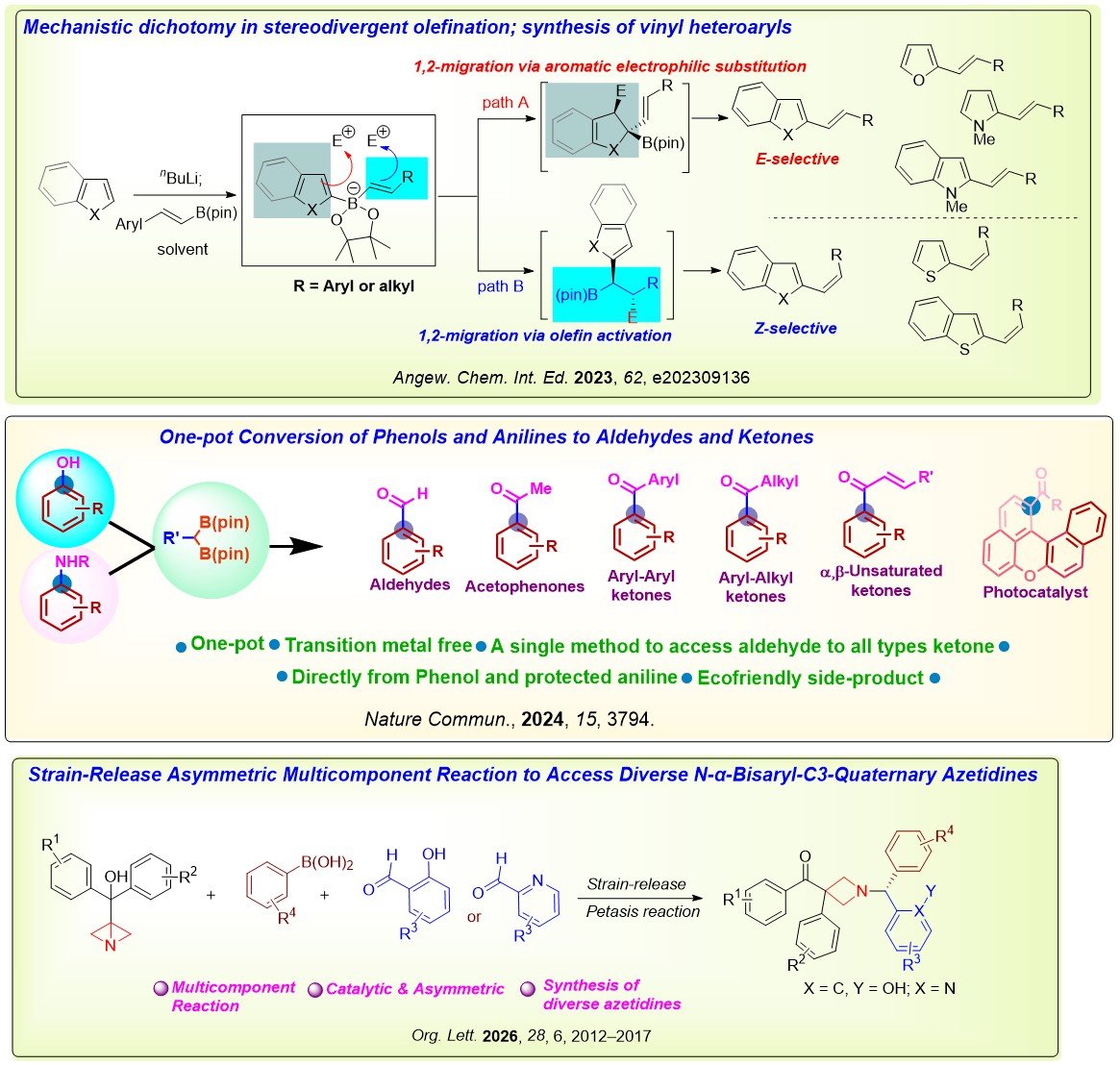
Our group's research in Organoboron Chemistry focuses on developing innovative, transition-metal-free synthetic methodologies to construct complex, geometrically pure molecular architectures. By leveraging the unique reactivity of organoboron intermediates, we have pioneered a stereodivergent Zweifel olefination to precisely toggle between E- and Z-vinyl heteroarenes using dual -system boronate complexes. Additionally, our team utilizes gem-diborylalkanes in strategic boron-Wittig reactions to access highly functionalized tetrasubstituted vinylboronates for the synthesis of bioactive molecules like Tamoxifen. Further, boron-Wittig reaction has been utilized for the synthesis of enyne-boronic esters and one pot conversion of phenol to benzaldehyde. Concurrently, we merge boron chemistry with strain-release strategies, employing organoboron inputs in multicomponent Petasis reactions to efficiently assemble densely functionalized nitrogen heterocycles for drug discovery.
ORGANOBORON CHEMISTRY

STRAINED RING CHEMISTRY

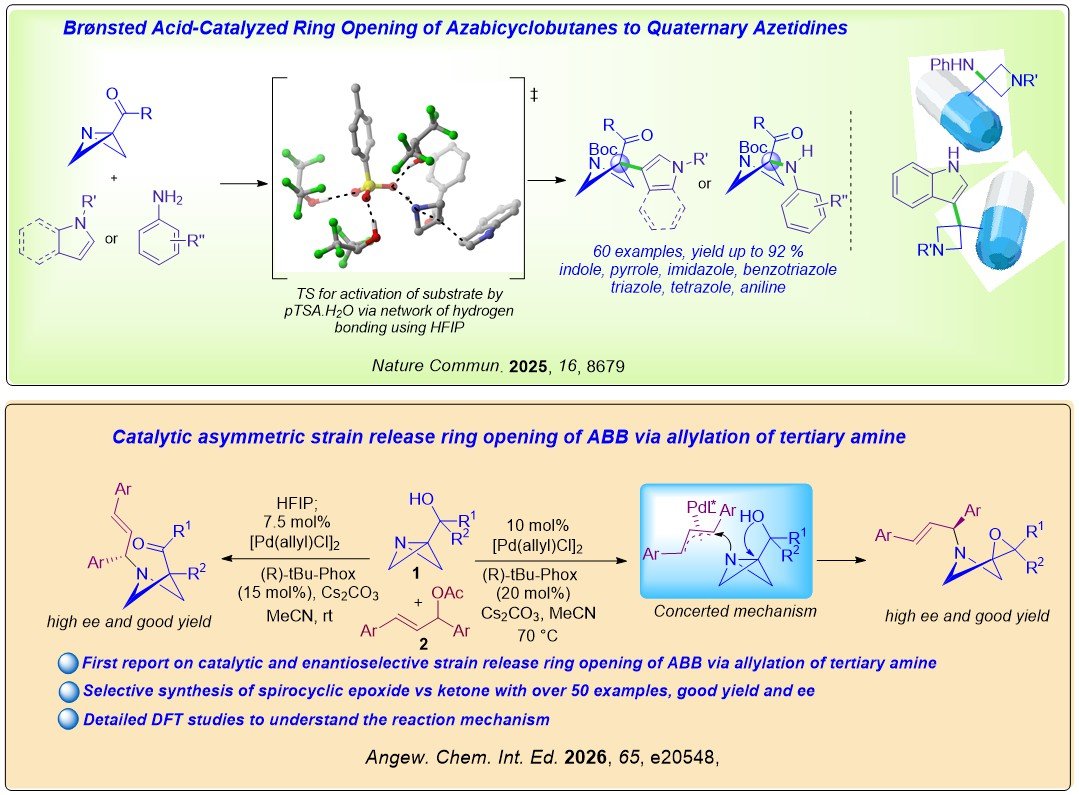
Our research in strained ring chemistry focuses on exploiting the high thermodynamic ring strain of small-membered nitrogen heterocycles to drive challenging bond-forming cascades. By designing strategic ring-opening and rearrangement pathways, we transform easily accessible but highly reactive intermediates such as 1-azabicyclo[1.1.0]butanes (ABBs) and azetidine derivatives into structurally complex, three-dimensional architectures. A core focus of our methodology involves utilizing cooperative solvent networks (like HFIP) or chiral catalyst systems to precisely control site-, regio-, and enantioselectivity during the strain-release process. Ultimately, these protocols offer an elegant, atom-economical platform to construct rigid and quaternary stereocenter-containing azetidine scaffolds that are highly valued in modern medicinal chemistry and drug discovery.

STRAINED RING CHEMISTRY

Photoredox chemistry

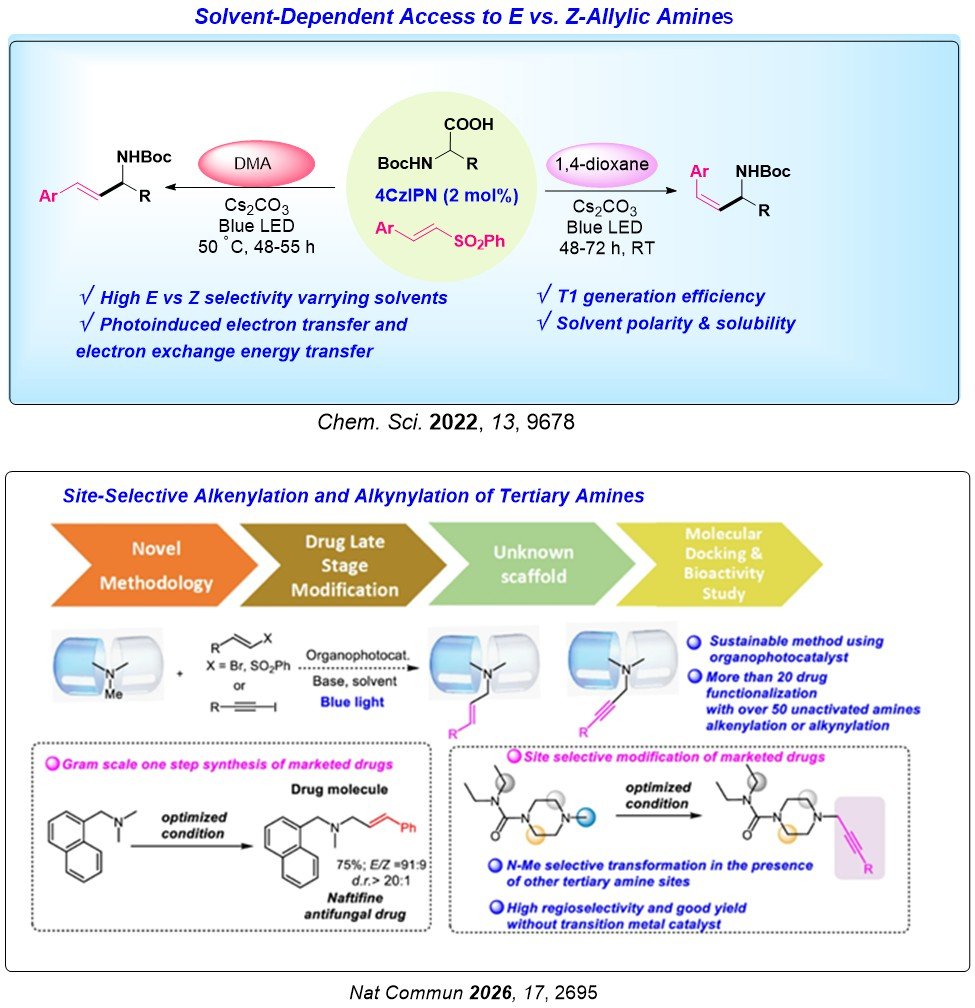
Our research in photoredox chemistry harnesses visible-light activation and sustainable organophotocatalysis to pioneer highly site-selective and stereoselective bond-forming methodologies under mild conditions. A primary focus involves exploiting transient radical pathways, where we utilize alkyl boronic esters as efficient radical sources; notably, our group has uncovered a striking mechanistic dichotomy in the solvent-dependent synthesis of geometrically distinct allylic amines via the decarboxylative vinylation of natural amino acids. Further, the chemistry has been extended to boronic acid and 1,2-bis-boronic esters. Recently, we have applied this chemistry on site-selective vinylation and alkynylation of tertiary amines and its application in the late stage functionalization of marketed drugs and bioactive compounds.

Photoredox chemistry